How it works
One figure, followed back to the code that produces it.
Take the month-end total on a management report. Someone signs it every month. Two questions sit behind it. Where does this figure come from, and what else does it feed?
Data lineage
From the whole estate down to one field.
Every figure starts somewhere, travels through your systems, is changed by steps on the way, and ends up in reports. The map shows all four, from the whole estate down to one field.
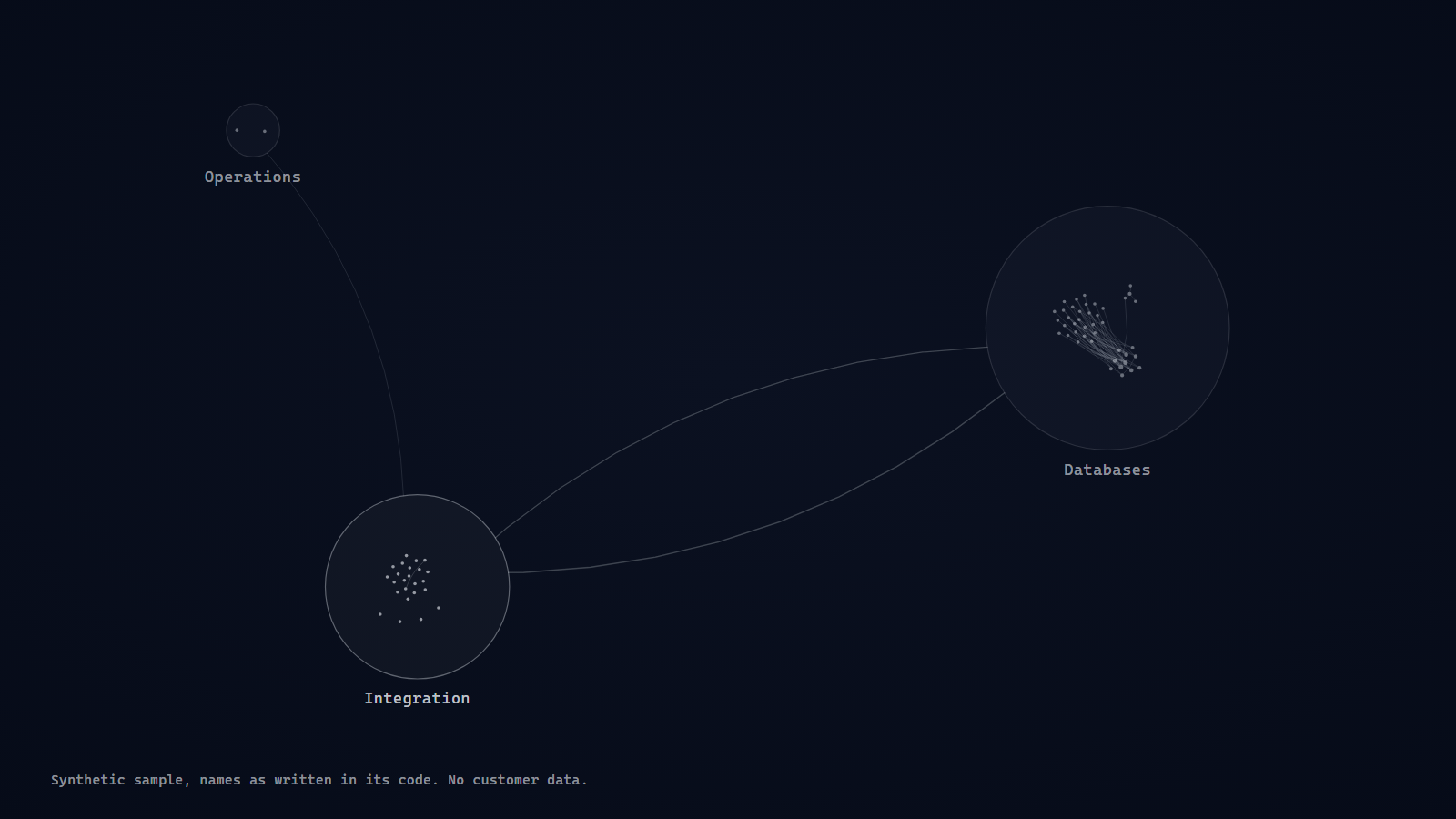
Synthetic sample, names as written in its code. No customer data. The report comes from one system on the map, and that one is fed by others.
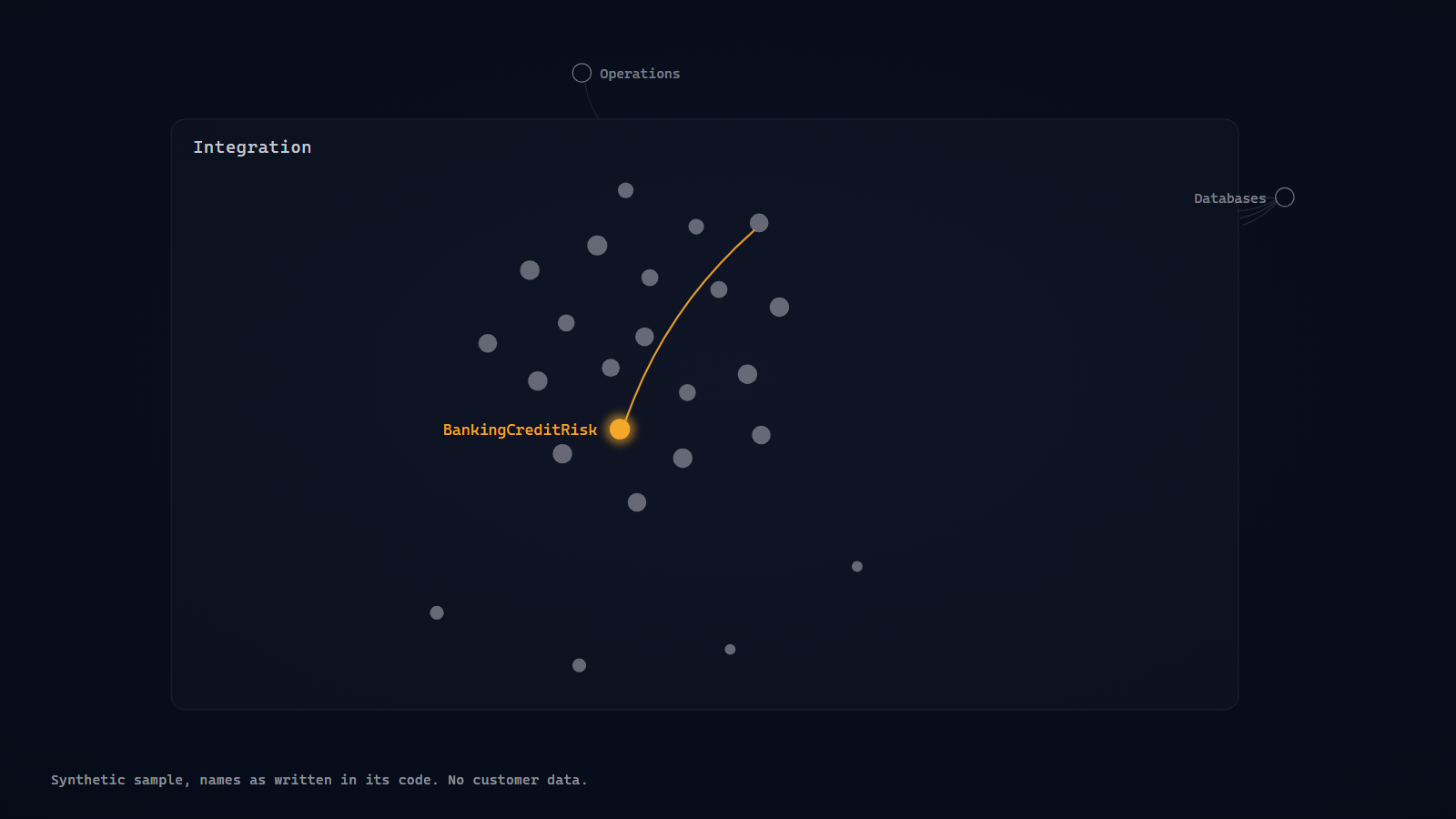
Synthetic sample, names as written in its code. No customer data. Opening it shows which systems feed the report.
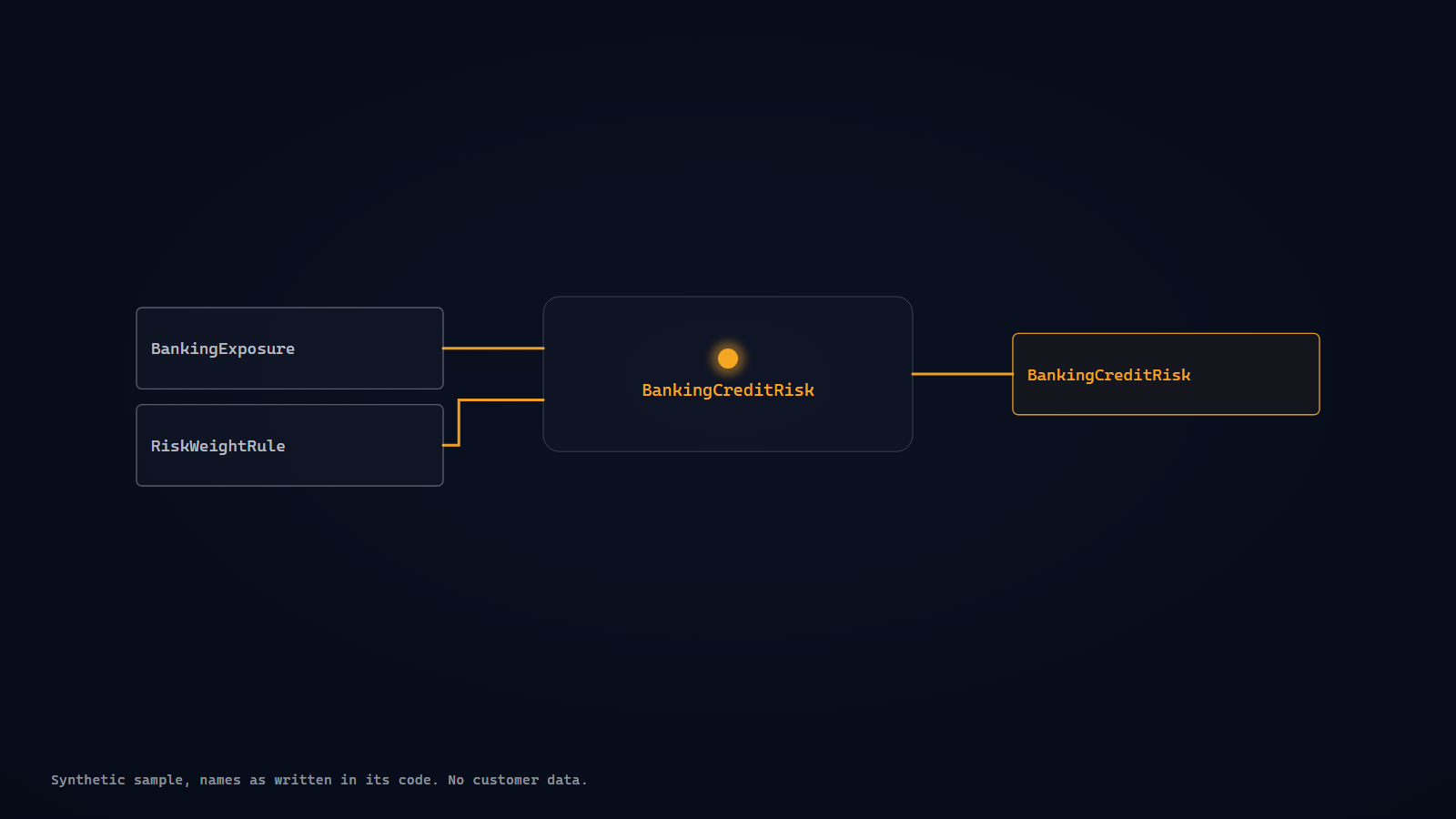
Synthetic sample, names as written in its code. No customer data. Inside that system is the program that calculates the figure, with its steps in order from the data it reads to the figure it writes.
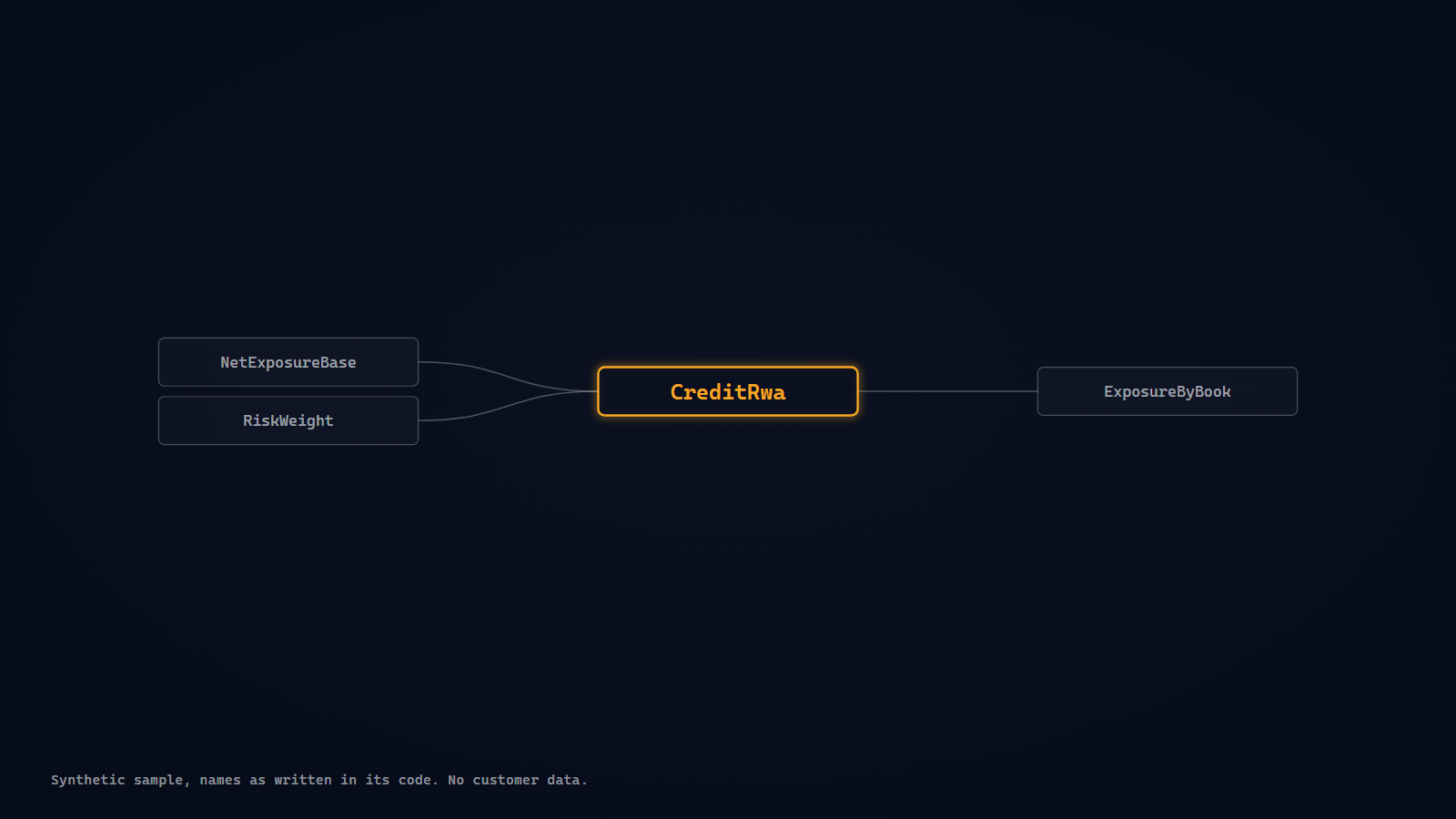
Synthetic sample, names as written in its code. No customer data. At the end of the path is the one field that holds the figure. You can see what feeds it and what reads it next. This is the level a regulator asks about. The industry calls it lineage. Cosmogenesis draws it from the code itself.
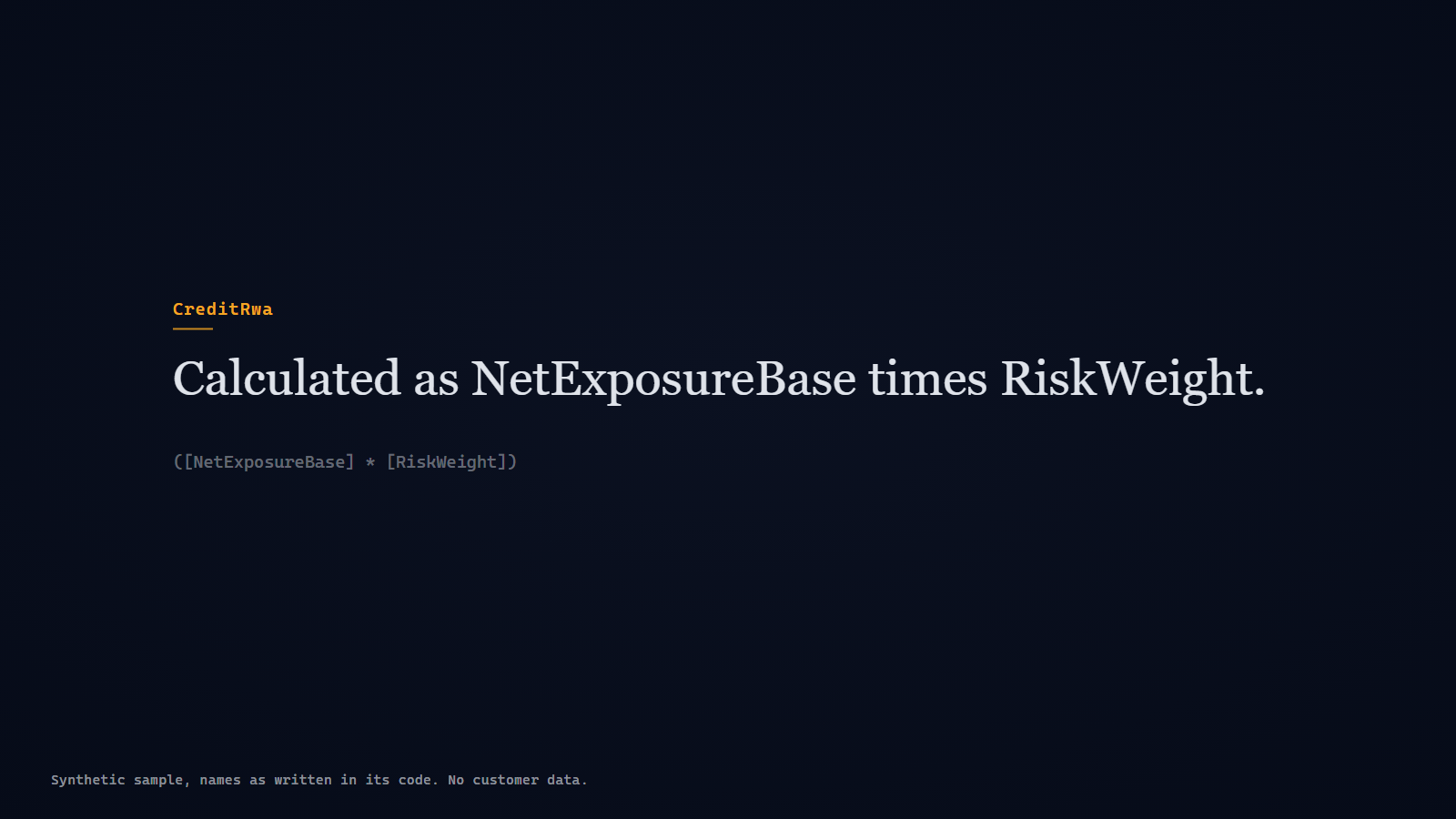
Synthetic sample, names as written in its code. No customer data. The analysis reads the code that sets that field and writes down what it does in one sentence a manager can read.
The code it came from sits beside the sentence, so an engineer can check that the sentence is right.
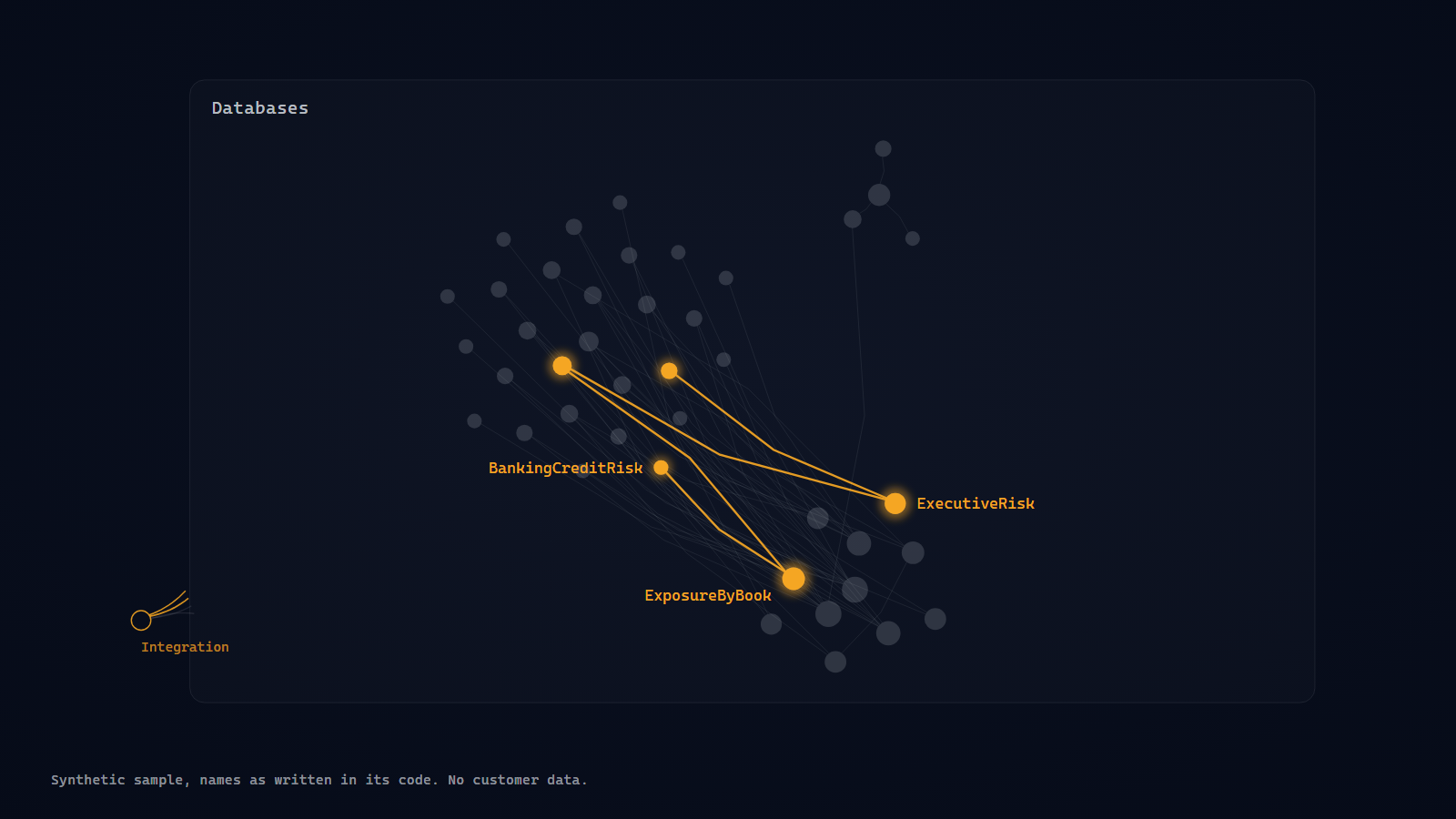
Synthetic sample, names as written in its code. No customer data. Before a change is approved, the same analysis shows which reports and figures it can reach, and where the path leaves the code, it says so.


The business rules
What the code decides, in plain English.
The analysis produced 64 business rules from this sample. Nineteen are calculations, 27 decide which rows are kept or removed, and 18 decide when a step runs. Seven are below, each with the code it came from.
- Keeps a row only when ValuedExposure BookClass is 'Banking'.
WHERE s.[BookClass] = 'Banking'; - Calculated as NetExposureBase times RiskWeight.
(DT_NUMERIC,19,4)([NetExposureBase] * [RiskWeight]) - Calculated as the total of BankingCreditRisk CreditRwa.
CAST(SUM(s.[CreditRwa]) AS decimal(19,4)) AS [CreditRwa], - Calculated as CreditRwa times 0.08.
(DT_NUMERIC,19,4)([CreditRwa] * 0.08) - Calculated as the number of PositionException rows.
CAST(COUNT_BIG(*) AS bigint) AS [ExceptionCount] - Calculated as (MarketValue ignoring its sign) times FxRate.
(DT_NUMERIC,19,4)(ABS([MarketValue]) * [FxRate]) - Keeps a row only when ValuedExposure BookClass is 'Trading'.
WHERE s.[BookClass] = 'Trading';
Synthetic sample, names as written in its code. No customer data.
It also covers the cases that seldom reach any document. These three lines come from the same sample, two beside a lookup of risk weights and one beside an exposure calculation.
- If several reference rows match, only the first one returned is used.
- Rows with no match stop the component, and the run fails.
- If ClassifiedPosition.MarketValue has no value, the condition cannot be decided, it does not match, and the value is 0.
On the way to that field the code makes decisions. It converts a unit, leaves out certain rows, applies a rate from another table and rounds the result. Each of those is a business rule, and the analysis states each one as a sentence a manager can read.
No AI model writes a word of it, so the same code gives the same answer every time, and every sentence can be checked against the code it came from.
Where the original authors left notes in the code, those notes are shown beside the analysis, marked as theirs and unchecked.
Three views
Three views of the same lineage.
Physical lineage shows what connects to what, from system to table to field, what a catalogue may call technical lineage. It is the richest view, and the one where the reach of a change is measured.
Logical lineage shows what the data means: the data elements and the business rules that derive them, lifted above how each system happens to store them.
Business lineage shows how data moves through your operations, in the processes, domains and topics your people already talk about, each tied to the systems beneath it.
All three come from the same analysis of the code, stay linked to one another, and can be sent to your catalogue or read through an API.
Documentation
A reference for every system, generated from the code.
The same analysis is delivered as documentation. Each system gets a searchable reference, with a page for every table that lists each field, where it comes from, what it feeds, the business rules that produce it and the code behind them.
It opens offline as a self-contained file, so it can be handed to an auditor or kept as the record of a system before it is retired. It states what was read and what was not, and it is produced again whenever the code changes.
What else it tells you.
Critical data and weak points
The analysis identifies your critical data elements from how data actually reaches your reports, using definitions you can adjust, and anything you have already declared critical stays declared. It also marks the weak points on the path, the steps where a figure can go quietly wrong, such as a join that multiplies rows or a conversion that drops precision. Each weak point comes with its evidence.
Where the answer stops
Every answer states what was read in full, what was read in part and what was not read, with the reason. It also states that it was read from the code as written rather than from a run. Where the path leaves your code, for example into a vendor's system, it says so at that point.
The same answer every time
The engine is deterministic and replayable. Run it again on the same code and you receive the same map and the same sentences, byte for byte. Change one line and only the parts that depend on that line change with it.
Your experts decide
Where the code alone does not settle an answer, the software raises it with the evidence attached. Your experts review it and decide, and the decision is kept with the report. After a migration, the same analysis reads the old system and the new one and compares what each decides.
Where it runs
The software runs as a self-contained application on infrastructure you control, or in an isolated environment we provide. It needs read access to the code and nothing else, and your data stays where it is.
Coexistence
Works with what you already have.
Your catalogue holds what has been harvested from your systems and what people have entered about your data. Cosmogenesis reads what happens in between, inside the code that does the calculating and the deciding, on old platforms and new. It states what that code decides in sentences anyone can check against the code, says what it did not read, and produces the analysis again when the code changes. Your catalogue, your governance workflow and your AI tools stay as they are and receive it.
Catalogue and governance.
All three views of lineage are published to Collibra and to the open standards OpenLineage and OpenMetadata as records for your stewards to accept, and published again when the code changes, so people see them in the tools they already work in. Ownership, policy and approvals stay where they are.
AI.
Models and agents can use the analysis through the API, and the software also prepares its output in a form built for a model to read. Each field comes with its meaning, the business rules that produce it and where the answer stops. Your AI gets evidence to stand on, and the engine that produces it is wholly deterministic and replayable, with no model in it.
Your own tools.
Everything the analysis produces is available through an API and as files, so your teams can build on it.
Infrastructure has had observability for years. Cosmogenesis brings the same discipline to the code your institution runs on.